The Streaming Stack Plan
A streaming bill you can defend line by line: every service at its price after the promo, unwatched months at full price, rotation instead of holding, annual plans only past break-even, bundles against what you would keep, a data cap and speed tier from our own figures, and the cord cut counted like for like
NonCable's calculators each answer one streaming question well, but they never meet. Streaming Cost adds whatever price you type, usually this month's promo. Bundle Savings compares a bundle with the full price of every service inside it. Our data tool plans 4K at 7 GB an hour while our bandwidth tool plans it at 25 Mbps, which is 11.25 GB an hour at that rate. And the cord-cut calculator subtracts the streaming bill from the cable bill, while the internet you keep changes price when the bundle goes. The Streaming Stack Plan works those gaps in seven steps. It prices every service after the promo, ranks an unwatched service as its whole price for nothing, rotates what you watch in bursts, pays annually only past the break-even month, tests a bundle against the services you would actually keep, budgets a data cap in your ISP's units, and counts the cord cut like for like with internet bought alone at the tier your busiest hour needs. For the worked household (an example) the stack reads $683.40 a year as typed and costs $755.40; after the plan the same viewing costs $477.62, and a bundle the calculator says saves $155.76 a year costs $122.02 more against the keep list. No streaming service, ISP or device is named, every price is an example for you to replace, and no saving is promised: the plan shows how to count one. Included: the 24-page PDF with seven steps, a stack sheet, a four-week viewing log, a rotation calendar, a cord-cut ledger, two reference tables and a quickstart, plus a personalised sheet worked from the numbers you entered in our calculator.
Look inside
Two full pages from the plan, exactly as printed. Click either to read it at full size before you decide.
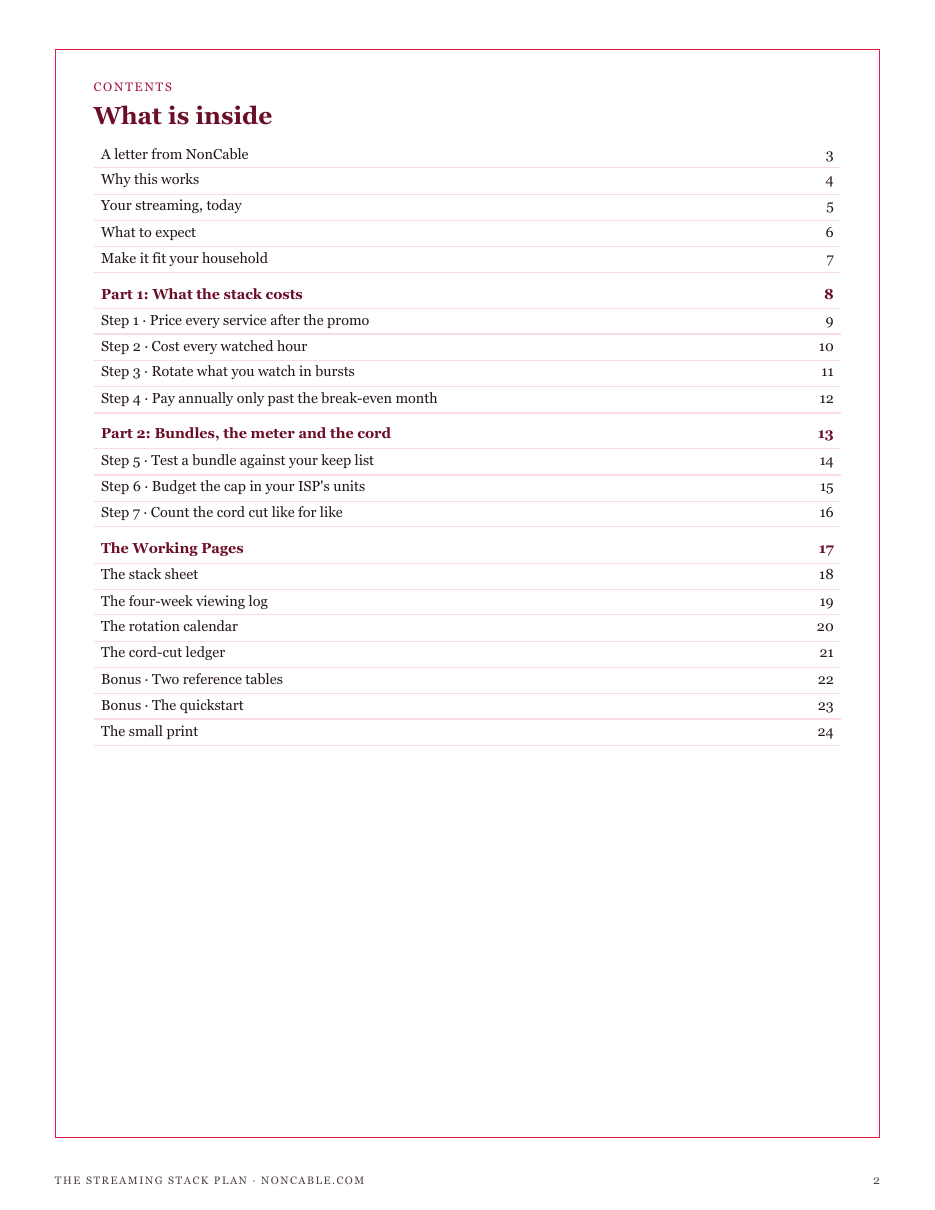
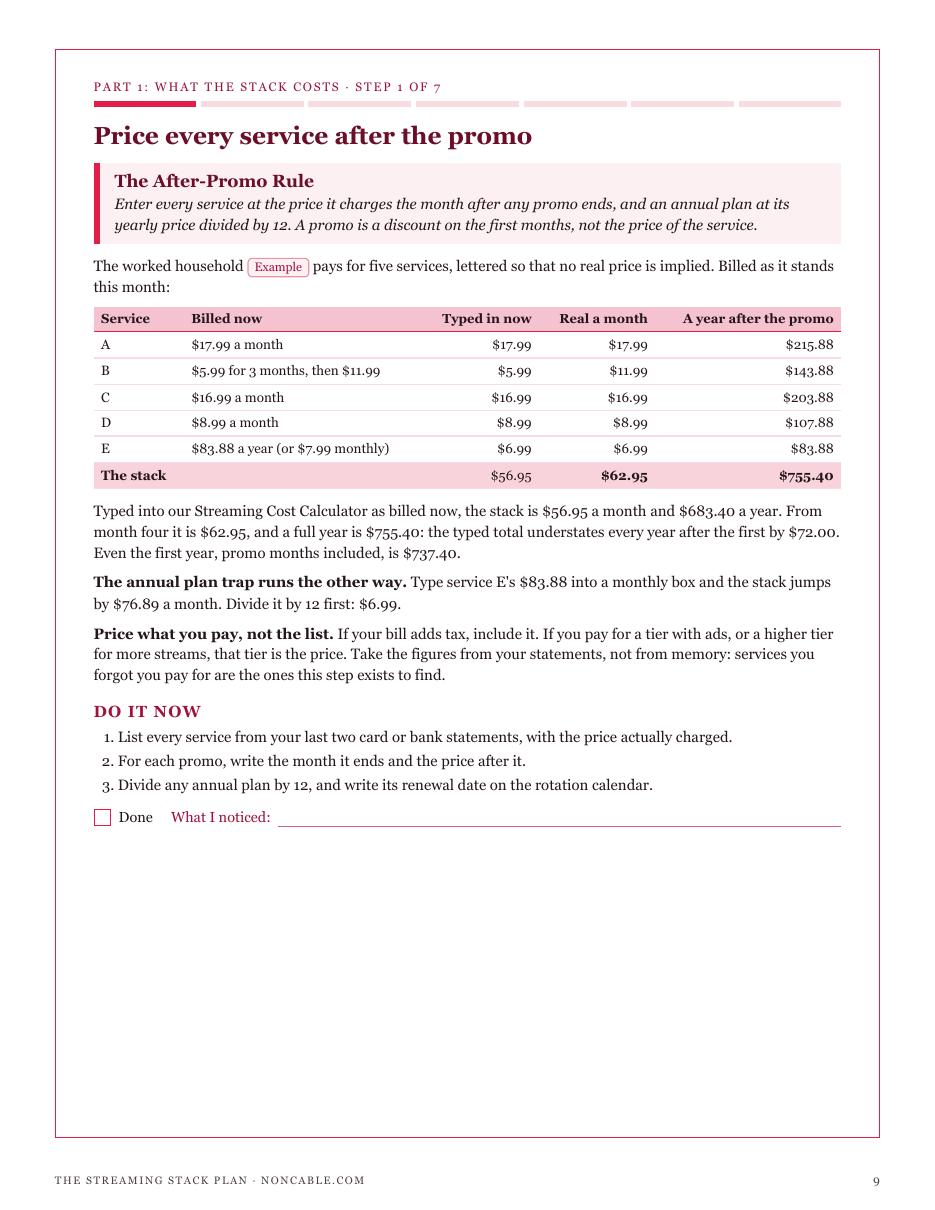
What is in it
- The After-Promo Rule: every service at its price after the promo, annual plans divided by 12, and what a promo price typed in hides over a year
- The Zero Hours Rule: cost per watched hour, with an unwatched service ranked as its whole price for nothing
- The Rotation Rule: hold, rotate or cancel, with the same hours a year bunched into the months your shows are on
- The Break-Even Month Rule: when an annual plan beats paying monthly, and why never for a service you rotate
- The Keep List Rule: a bundle priced against what you would actually pay under your plan, and the most it can cost
- The Meter Rule: our GB-an-hour and Mbps figures reconciled, a data cap budgeted in your ISP's units, and the quality setting as a data plan
- The Like-for-Like Rule: the cord cut counted as a whole year before and after, with internet alone at the tier your busiest hour needs
- Four working pages: a stack sheet, a four-week viewing log, a rotation calendar and a cord-cut ledger
- Two reference tables: Mbps to GB a month, and cost per watched hour by price and hours
- A quickstart and a personalised sheet worked from the numbers you entered in our calculator
- ✓ 24 printable pages
- ✓ 10 sections, worksheets and templates
- ✓ A second PDF worked out from the numbers you enter
- ✓ No account needed, just an email address
- ✓ Instant download; link valid 7 days
Price includes any taxes. Sold by GrabURL, who handle checkout and support. The charge appears on your statement as GrabURL.
The plan picks up where the free Streaming Cost Calculator and Subscription Cost Per Hour Calculator leave off. It prices every service at its price after the promo, ranks an unwatched service as the whole price for nothing, rotates what you watch in bursts, and pays annually only past the break-even month. It tests a bundle against the services you would keep rather than their full standalone total, as the Bundle Savings Calculator does; reconciles the Streaming Data Usage Calculator’s GB an hour with the Streaming Bandwidth Calculator’s Mbps to budget a data cap and pick a speed tier; and counts the cord cut like for like, with internet bought alone. No streaming service, ISP or device is named, and every price in it is an example for you to replace with the one on your own bill. It is not financial advice, and no saving is promised.